
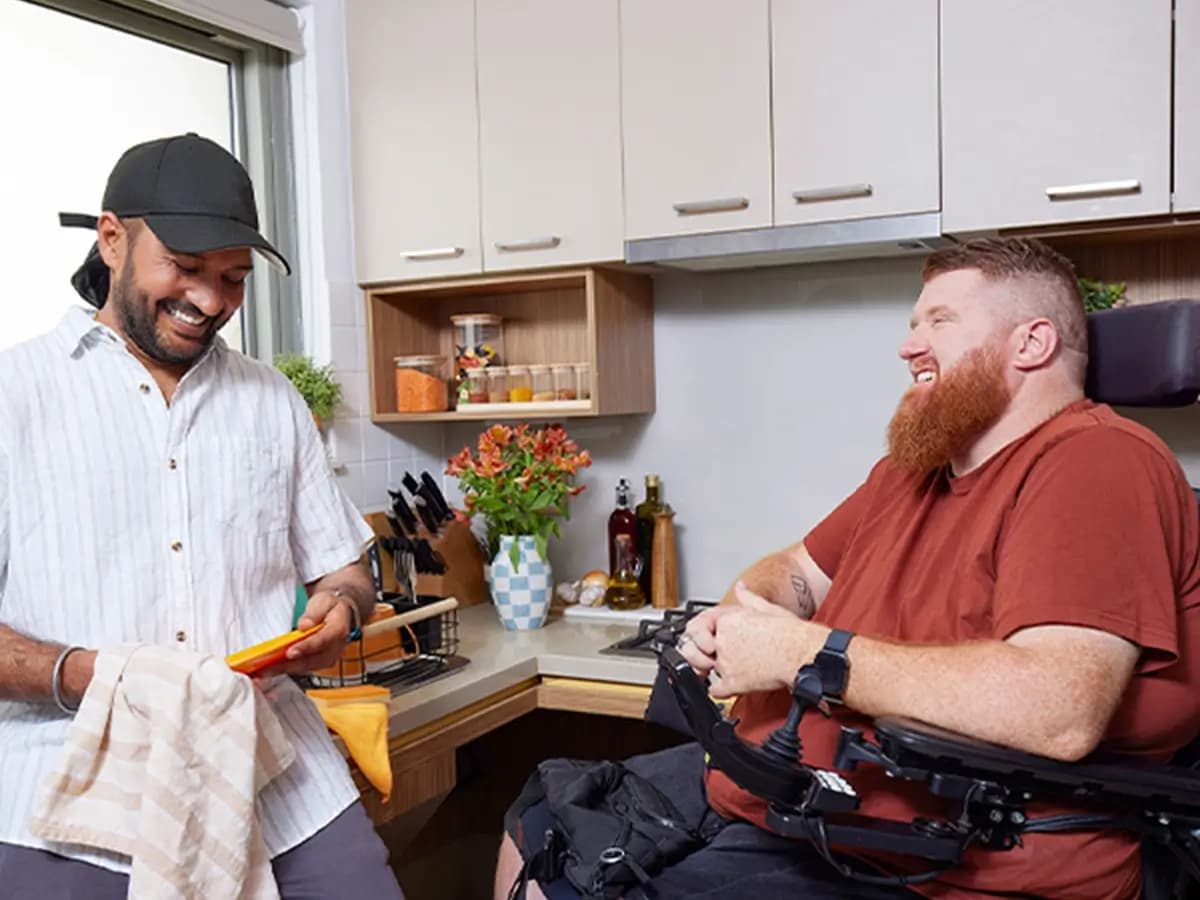
When the default housing options don't feel right, what comes next?

Home and LivingNDIS Coordinators

Last updated

3 June 2025

Reading time

3 min read

Share

Working together to uncover better-fitting housing and support options

This article was written by Libby Ellis, lead consultant at Mable Home and Living Consultants. With over 25 years experience in the disability sector, Libby has helped hundreds of people navigate systems and funding to achieve their goals.

I've spoken with many Support Coordinators who think beyond traditional options about housing and support for their clients. They're asking questions about how to move past system-driven models that don't quite fit.

It's common to hear, "The person doesn't want a group home, and I don't think it is the right option—but it's very difficult to achieve something else."

This is a real challenge in the sector, and it is part of the reason we set up the Home and Living Consultancy at Mable.

A lot of people are ready—but stuck

The clients we work with often reach a point where they want something different and don't feel like things are working as they should. Sometimes, this is prompted by a change—like an ageing parent, greater accessibility needs, or a change in support needs. Other times, it's just a growing sense that life could look different. However, the options available don't always reflect the nuance of what the person wants or needs.

In addition to this, it can be difficult to balance the time to unpack the complexity of housing options with the practical demands of eligibility evidence, housing availability, funding rules, and timelines.

This is where we come in

We created the Mable Home and Living Consultancy to be a place where NDIS participants can stop, take stock, and plan clearly.

We work with NDIS participants to build capacity and understanding by:

  • Taking a step back from the system and reconnect with their own idea of what home means.
  • Unpacking what kind of support they actually need—and how it might be delivered.
  • Understanding and navigating what the NDIS can (and can't) fund in this area.
  • Identifying practical safeguards when concerns like safety or being alone are raised.
  • Rebuilding momentum after plans have stalled or gone off track.

When we work with NDIS participants, we do so in a way that complements the work of Support Coordinators, so that all involved parties can see the broader picture of your client's goals and supports.

Our consultancy helps participants to focus on the housing-specific parts of their goals, which often take more time and bandwidth. The service works best when there's some space to think and plan beyond an urgent need or an immediate housing risk or to prevent this happening

Does this sound familiar?

If you're supporting someone who's ready for a different kind of housing and support arrangement but cannot see a clear path forward, I'd be glad to have a conversation.

Enquire now to explore more.

You might be interested in

Disabled mums are the quiet supermums
As the water trickled over the rocks and my kids explored the bush, their laughter mingling with birdsong, I sat quietly on the wooden seat, taking it all in. The peace, the joy - but also something else. My eyes welled up just as my independent support worker glanced at me. She slipped an arm around me and gave a gentle squeeze. I didn't need to explain what I was feeling but she already knew. That feeling is something that I think every parent living with a disability needs to hear and embrace. A different kind of angst Mum - and dad - guilt is almost synonymous with parenting these days. We worry we're not doing enough, not being enough; that there's never enough time, money, or energy. But when you're parenting with disability, that feeling cuts deeper. It's the sting when you can't do something for, or with, your kids. Like driving them to a birthday party, kicking a soccer ball in the backyard. It's crying quietly in the kitchen when disability and parenthood all feels too much.
Independent Thoughts: Melissa and Simone
Independent Thoughts digs deeper into what it really means to live on your terms, sharing insights into life for people with disability and older Australians. We invite guests with lived experience to share their perspectives in an open dialogue. From casual chats to asking some of life's biggest questions, Independent Thoughts covers it all. Independent Thoughts is an invitation to join us as we challenge the status quo, shatter stereotypes, and redefine independence – one open-hearted conversation at a time. In this episode, we meet Simone, who manages support for her dad, Con, through Mable. She speaks with host and Clinical Psychologist, Melissa Levi . Finding the right support Dogs, flowers and a veggie garden. These are three things that bring Con joy, according to his daughter, Simone. But as he got older, it became physically harder for him to stay connected to the parts of life he loved. When Con and Simone felt it was time to begin looking for help at home, it was import
NDIS reforms announced: What we know so far
On 22 April 2026, Health Minister Mark Butler announced major reforms to the National Disability Insurance Scheme (NDIS). The changes have been described as a 'reset' with the intention to refocus the scheme, reduce spending and ensure long-term sustainability. While the reforms are wide-ranging, they will not take effect immediately and will be introduced gradually over time. The Government will introduce the National Disability Insurance Scheme Amendment (Securing the NDIS for Future Generations) Bill next month, then there will be a lot of debate and community consultation before we see any changes take effect. Here's an explainer of the announcement and the key takeaways. Why the 'reset'? The NDIS was established to support people in Australia living with 'permanent and significant disability' 13 years ago. Since then, its rapid growth has seen the scheme expand much faster than originally forecast. Spending increasing by 10-14 per cent per year. Today, there are more than 75