

Top tips on writing your Mable support worker bio

Support Workers

Last updated

24 Nov 2015

Reading time

3 min read

Share

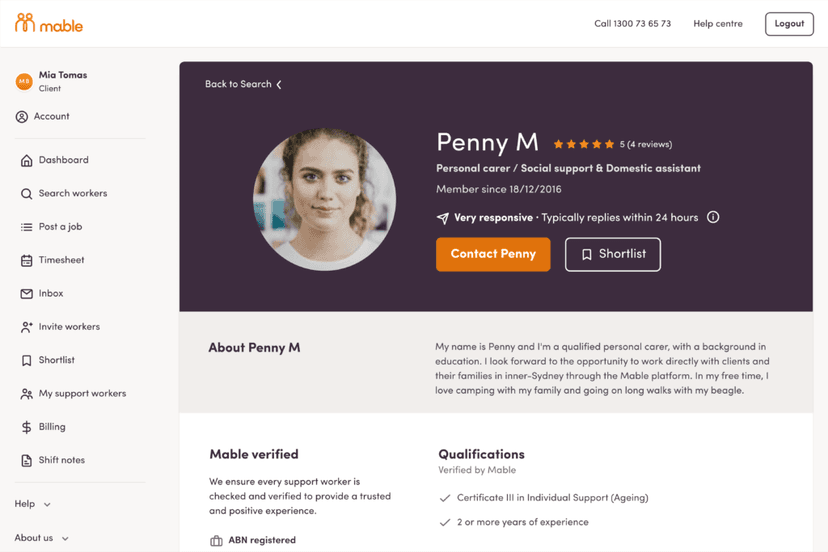
If you're an independent support worker on Mable, your bio is an opportunity to tell clients about yourself. Your bio sits directly underneath your profile photo and can include details about you, such as:

  • Your motivation for becoming a support worker
  • Your interests and hobbies (for example, hiking)
  • Your skills (for example, you play the piano)
  • Your background and experience
  • Your achievements
  • Your personality traits or qualities (for example, your organisational skills).

A well-written bio can lead to connecting with more clients, potentially leading to more bookings. It can be tricky to write about yourself, so we've sourced some tips to help you write the best Mable profile possible.
Dos and don'ts

Top tips

  • Your bio should be concise, including only relevant information. Aim for 150-200 words
  • Highlight your achievements
  • Have your most important information at the beginning, not in the middle or the end
  • Sound professional and approachable
  • Ensure your bio has correct spelling and grammar
  • Give a timeframe for when you aim to respond to messages
  • Use short, easy-to-read sentences.

Things to avoid

  • Do not include your qualifications in your bio. This ensures the Mable team can approve your profile as quickly as possible. Include your qualifications only in the 'Education/Work history' section
  • Do not abbreviate or use colloquial language
  • Don't write a bio that's too long, not all clients can or will read a long bio
  • Do not give away your last name or contact details. For your safety, all communication should go through the Mable platform, including Team Chat. You will not be insured if you do not book work through the Mable platform.

Here's an example of a good, concise bio:

Hi, my name is Jill. I’m a qualified nurse who earned my degree six years ago. I now work full-time in Melbourne. Being a nurse is a dream come true, it was something I wanted to be since a child and here I am! I value building lasting connections with clients, providing dignity and respect with my services.

I always take the time to learn about my clients, and helping them maintain independence is incredibly rewarding — it’s my favourite part of the day. Away from work, I have two dogs and always enjoy showing off photos of their mischief. I also enjoy keeping yoga and running. If you have any questions, please message me on Mable. I aim to respond within 24 hours. Over the weekend, please allow a little extra time for me to get back to you.

Want more tips on improving your worker profile on Mable? Watch the video below.

You might be interested in

Disabled mums are the quiet supermums
As the water trickled over the rocks and my kids explored the bush, their laughter mingling with birdsong, I sat quietly on the wooden seat, taking it all in. The peace, the joy - but also something else. My eyes welled up just as my independent support worker glanced at me. She slipped an arm around me and gave a gentle squeeze. I didn't need to explain what I was feeling but she already knew. That feeling is something that I think every parent living with a disability needs to hear and embrace. A different kind of angst Mum - and dad - guilt is almost synonymous with parenting these days. We worry we're not doing enough, not being enough; that there's never enough time, money, or energy. But when you're parenting with disability, that feeling cuts deeper. It's the sting when you can't do something for, or with, your kids. Like driving them to a birthday party, kicking a soccer ball in the backyard. It's crying quietly in the kitchen when disability and parenthood all feels too much.
Independent Thoughts: Melissa and Simone
Independent Thoughts digs deeper into what it really means to live on your terms, sharing insights into life for people with disability and older Australians. We invite guests with lived experience to share their perspectives in an open dialogue. From casual chats to asking some of life's biggest questions, Independent Thoughts covers it all. Independent Thoughts is an invitation to join us as we challenge the status quo, shatter stereotypes, and redefine independence – one open-hearted conversation at a time. In this episode, we meet Simone, who manages support for her dad, Con, through Mable. She speaks with host and Clinical Psychologist, Melissa Levi . Finding the right support Dogs, flowers and a veggie garden. These are three things that bring Con joy, according to his daughter, Simone. But as he got older, it became physically harder for him to stay connected to the parts of life he loved. When Con and Simone felt it was time to begin looking for help at home, it was import
NDIS reforms announced: What we know so far
On 22 April 2026, Health Minister Mark Butler announced major reforms to the National Disability Insurance Scheme (NDIS). The changes have been described as a 'reset' with the intention to refocus the scheme, reduce spending and ensure long-term sustainability. While the reforms are wide-ranging, they will not take effect immediately and will be introduced gradually over time. The Government will introduce the National Disability Insurance Scheme Amendment (Securing the NDIS for Future Generations) Bill next month, then there will be a lot of debate and community consultation before we see any changes take effect. Here's an explainer of the announcement and the key takeaways. Why the 'reset'? The NDIS was established to support people in Australia living with 'permanent and significant disability' 13 years ago. Since then, its rapid growth has seen the scheme expand much faster than originally forecast. Spending increasing by 10-14 per cent per year. Today, there are more than 75