
A note on language: The author has chosen to use identity-first language.
"[We can] view coming into disability as a birth, not a death." I read those words in Care Work, by Leah Lakshmi Piepzna-Samarasinha, last year.
I closed the book and sat with how the words made me feel. Powerful. Hopeful. I reopened the book to read them again. And again. I wanted to hold onto the words, to see myself and my disability in a new way.
Piepzna-Samarasinha was saying that disability doesn't have to mean tragedy. They explain that many of us live proud and meaningful lives, not tragic ones, often with the support of older or more experienced disabled people. Those older or more experienced disabled people can be known as 'disability doulas' within the community.
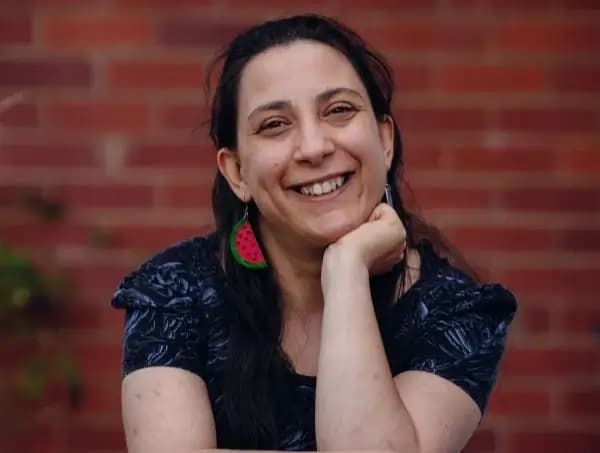
My mentor, Akii
I am lucky to have been guided by several disability doulas, including my friend Akii.
I'm not newly disabled, so it might seem odd that I would need this kind of support. But I am new to identifying as disabled, and my disability has changed in the last few years. As a result, I've had to unlearn more than two decades of ableism, a task that is ongoing and exhausting.
As I began to challenge my understanding of disability, I entered the world of disability advocacy. I met Akii when I became a member of the minister-appointed Victorian Disability Advisory Council, of which she was already a member.
From the beginning, Akii supported me, and I supported Akii. They made sure that my comments were acknowledged, and they agreed when I explained how things could and should be accessible. And I tried, without speaking on their behalf, to correct people who misgendered them.
Akii is a mentor for several people, not just me. By centering the marginalised parts of their identity, and showing disability pride, they support me (and other disabled people) to do the same.
What disability pride means to me
Disability pride means different things to every disabled person. For me, it's about refusing to feel shame around my disability, and refusing to try to push myself beyond my limits to seem 'less disabled' or meet nondisabled expectations.
I've come a long way with disability pride over the past few years, but I've still got so far to go.
The most disabling symptom of my cerebral palsy is muscle spasms, which cause pain and fatigue. I use a wheelchair to travel any further than a few hundred metres, which helps stop the spasms a little. But they still happen often, usually when I'm cold, hungry, tired, or stressed.
I don't usually take pain medication or get remedial massages because I know my pain is minor compared to that of others – especially Akii's. Yet they remind me every time I see them that I'm allowed to take pain medication, that my pain matters. This is disability pride – a positive shift in how we value ourselves and how we expect others to value us.
Disability pride in action
Recently, I had to advocate for my access needs when I applied for a job. I reached out to several people for advice, fearing that I was "too much," that I should just suck it up and work without my reasonable adjustments.
Akii told me that I should speak up about what I needed. They told me how they'd been in a similar position more times than they can count and had successfully spoken up for themselves.
They pointed out that by staying silent I would make it easy for the organisation to potentially discriminate against other disabled people in the future.
Their advice empowered me to advocate for myself. I didn't get the job, but speaking up for what I needed was more important.
Not everyone is lucky enough to have a mentor like Akii in their lives, but we can find community and pride in our own ways. I'm going to take up space in my glorious, messy, disabled way. And maybe one day, I can be a disability doula for someone else.
Laura Pettenuzzo is a disabled writer living on Wurundjeri Country. Her work has appeared in places such as The Age, Griffith Review and ABC Lifestyle. She also runs All for Access, a disability-led Easy Read and accessible communications business.


